
Unmasking the NNA | Investigation No. 2
The CFPB Connection: Who Made the Rules?
From Federal Service-Provider Oversight to Private Industry Standards.
By Tye Brown | National Notary Coalition
· 8 min read
In Part 1 of Unmasking the NNA, the National Notary Coalition examined a federal class-action settlement involving the National Notary Association, Signix, and background-check practices.
The investigation examined the settlement agreement, the missing cash-election form, and a sworn declaration acknowledging that the form had been omitted from emailed notices.
But the history of background checks did not end with that settlement.
In 2012, the Consumer Financial Protection Bureau issued guidance addressing how supervised financial institutions should oversee their service providers.
In 2013, the Signing Professionals Workgroup published industry standards addressing notary signing-agent qualifications and practices.
Those standards included background screenings, examinations, professional conduct, signing procedures, and errors and omissions insurance.
This raises an important question:
How did federal expectations concerning service-provider oversight influence the development of private industry standards for independent notaries?
To understand that question, we must examine the original documents.
The documented history
From background checks to industry standards
The lawsuit, settlement, federal guidance, and private standards are distinct events. Their sequence does not establish that one caused another.
2008
The Federal Background Check Lawsuit
A federal class-action lawsuit involving Signix and the National Notary Association raised allegations concerning background-check practices under the Fair Credit Reporting Act.
The case provides historical context for the NNA's involvement in background-screening services.
Read Part 1 — The Missing Cash FormWhy this matters
Background checks were already part of the NNA-related business landscape before the SPW standards were published. The allegations were resolved through settlement, not a trial finding that every alleged violation occurred.
2010
The Missing Cash-Election Form
The federal settlement provided certain class members with a choice between an NNA goods-or-services benefit and cash.
A sworn declaration filed May 17, 2010 acknowledged that the cash-election form was inadvertently omitted from emailed settlement notices.
Why this matters
The settlement is part of the documented history of background-check practices. This is the direct connection between Part 1 and Part 2.
Sources: Document 39-1, settlement terms; Document 46-3, paragraph 4.
Read the missing-form discussion in Part 12012
The CFPB Issues Service-Provider Guidance
On April 13, 2012, the Consumer Financial Protection Bureau issued Bulletin 2012-03.
The bulletin addressed the responsibilities of supervised financial institutions when using third-party service providers.
The guidance discussed appropriate due diligence, contractual expectations, monitoring, and responding to identified compliance concerns.
Why this matters
Financial institutions may use outside businesses to perform services. However, engaging a service provider does not automatically eliminate the institution's responsibility to comply with applicable federal consumer financial law.
The investigative question
What does the CFPB actually require? And how does that differ from standards developed by private industry organizations?
2013
The Signing Professionals Workgroup
The Signing Professionals Workgroup developed industry standards addressing notary signing-agent qualifications and practices.
The original standards addressed:
- Background screenings.
- Annual examinations.
- Professional conduct.
- Standardized signing procedures.
- Errors and omissions insurance.
The SPW's 2013 Rules and Procedures describe the NNA's role in creating the workgroup and its purpose of developing standards intended to assist industry participants with compliance obligations.
Why this matters
The SPW standards were developed through an industry initiative. They were not themselves federal statutes. Our investigation examines the relationship between federal regulatory expectations and the standards developed by industry participants.
The investigative questions
Who participated in developing the standards? Why were particular screening criteria selected? How were the standards implemented by hiring companies? Did the CFPB require notaries to purchase background checks from a particular company?
Exhibit B-1 · SPW Rules and Procedures — Version 1.1Exhibit C-1 · Certified Signing Specialist Code of ConductLater documents: Version 2.0 of the procedures is dated March 15, 2017. The uploaded 08-26 screening document is undated and is not presented as the original 2013 standards.Part 3 — Inside the Signing Professionals Workgroup Coming Soon
2016
The CFPB Clarifies Service-Provider Guidance
In 2016, the CFPB amended and reissued its service-provider guidance.
The revised guidance clarified that risk-management practices may vary depending on the nature and risks of a service-provider relationship.
Why this matters
The CFPB's expectations regarding service-provider oversight should not be confused with a universal requirement for every participant to undergo identical screening.
Today
The Accountability Question
The National Notary Coalition is examining how oversight responsibilities and private industry standards affect independent notaries.
Notaries may be required to satisfy background-screening, insurance, certification, and other qualifications before receiving assignments.
But what oversight applies to the businesses hiring those notaries? What happens when signing services allegedly fail to pay for completed assignments?
Who evaluates those businesses before assigning them work? And what responsibilities do the companies contracting with them have?
These questions will be examined more deeply in a future article. They are investigative questions, not findings that any specific company failed its obligations.
Part 5 — Who's Vetting the Signing Services? Coming Soon
Evidence library · Part 2
Examine the original documents
Six source documents, including both dated versions of the SPW procedures and the uploaded 08-26 screening standards. Dates below come from the documents themselves; an undated copy is not assigned a revision year.
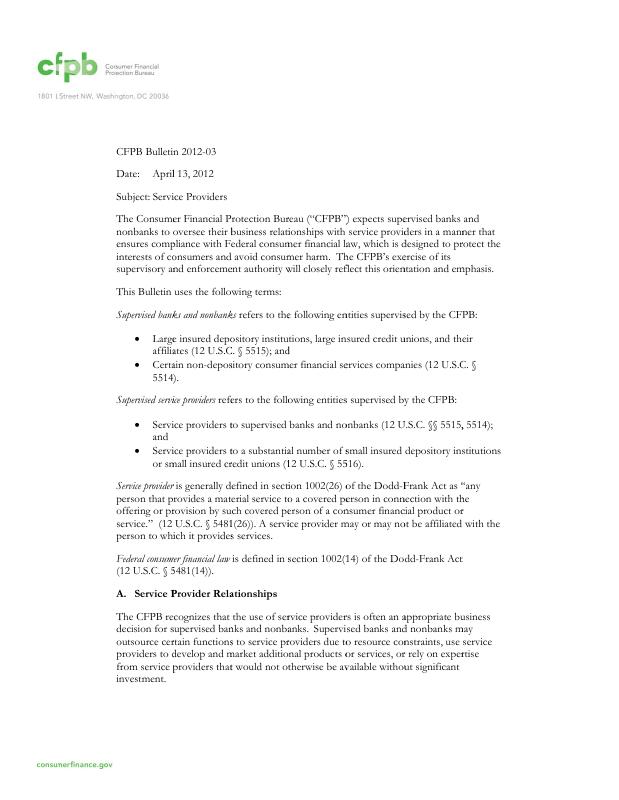
CFPB Bulletin 2012-03 — Service Providers
April 13, 2012
Consumer Financial Protection Bureau
Federal guidance on due diligence, contracts, monitoring, and compliance responsibilities when supervised financial institutions use service providers.
SPW Rules and Procedures — Version 1.1
December 4, 2013
Signing Professionals Workgroup
The 2013 procedures describe the NNA's role in creating the workgroup, its governance, and the development of private industry standards.
SPW Rules and Procedures — Version 2.0
March 15, 2017
Signing Professionals Workgroup
A later dated version of the procedures. Compare it with Version 1.1 to examine how the workgroup's written procedures evolved.
Certified Signing Specialist Code of Conduct
October 14, 2013
Signing Professionals Workgroup
The original dated code addresses professional conduct and signing practices. This is the code of conduct, not a separate complete 2013 standards document.
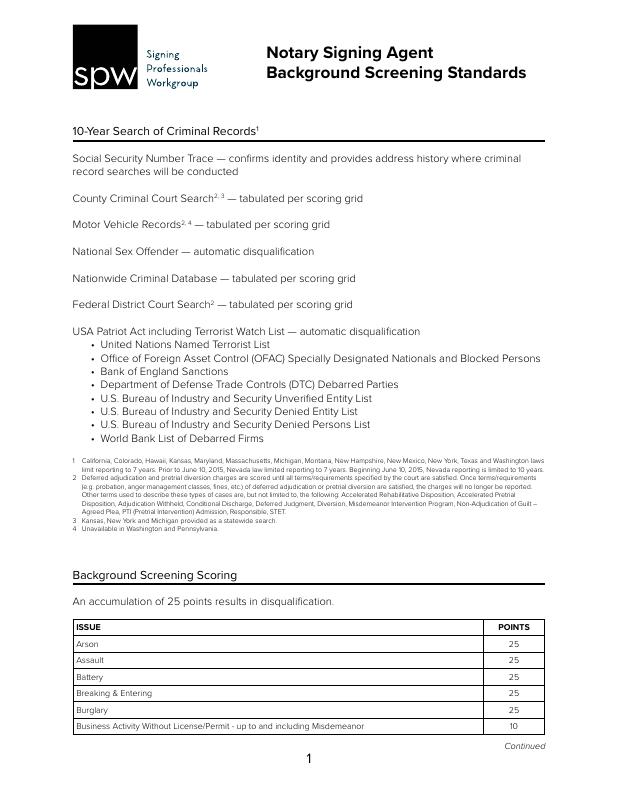
Notary Signing Agent Background Screening Standards (08-26)
Undated uploaded copy
Signing Professionals Workgroup
The uploaded 08-26 file includes search criteria and a 25-point scoring grid. It references a June 10, 2015 Nevada law change, but prints no publication date; the filename does not establish an August 2016 revision.
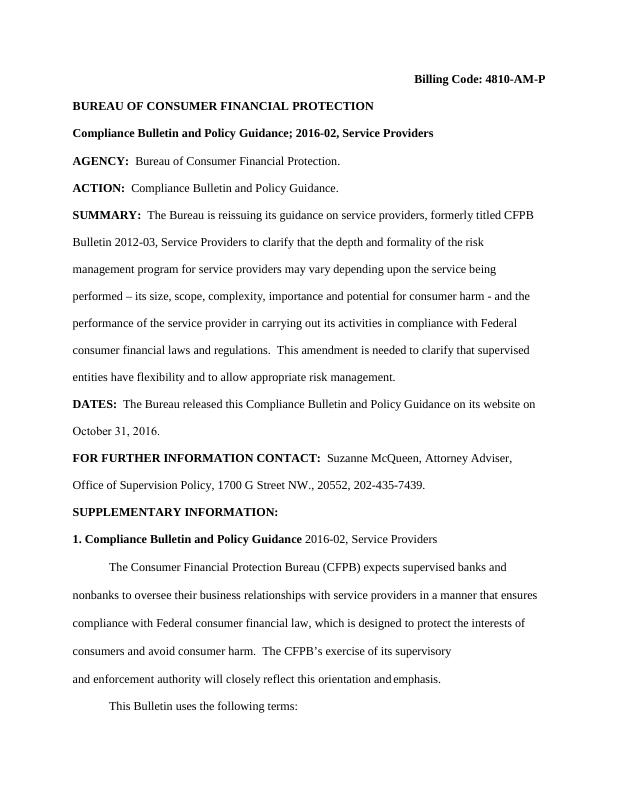
CFPB Compliance Bulletin and Policy Guidance 2016-02 — Service Providers
October 31, 2016
Consumer Financial Protection Bureau
Amended and reissued guidance explains that risk-management practices may vary with the nature and risks of the service-provider relationship.
Why the National Notary Coalition is investigating
The National Notary Coalition believes independent notaries deserve transparency about the standards affecting their businesses.
We support appropriate consumer protections and professional accountability.
But we also believe accountability should be examined throughout the mortgage-closing process.
Our ongoing investigations will explore the responsibilities of lenders, title companies, signing services, and independent notaries.
NNC is also exploring ways to help notaries develop direct business relationships and reduce unnecessary dependence on intermediaries.
Future articles will examine these subjects in greater detail.
Awareness • Advocacy • Transparency
This article distinguishes documented records, allegations made in litigation, and investigative questions. Federal guidance and private standards are not interchangeable. NNC does not verify individual Notary Watch reports or make findings of wrongdoing.
Follow the investigation
Subscribe to The Brief for investigative updates and the next installment of Unmasking the NNA.